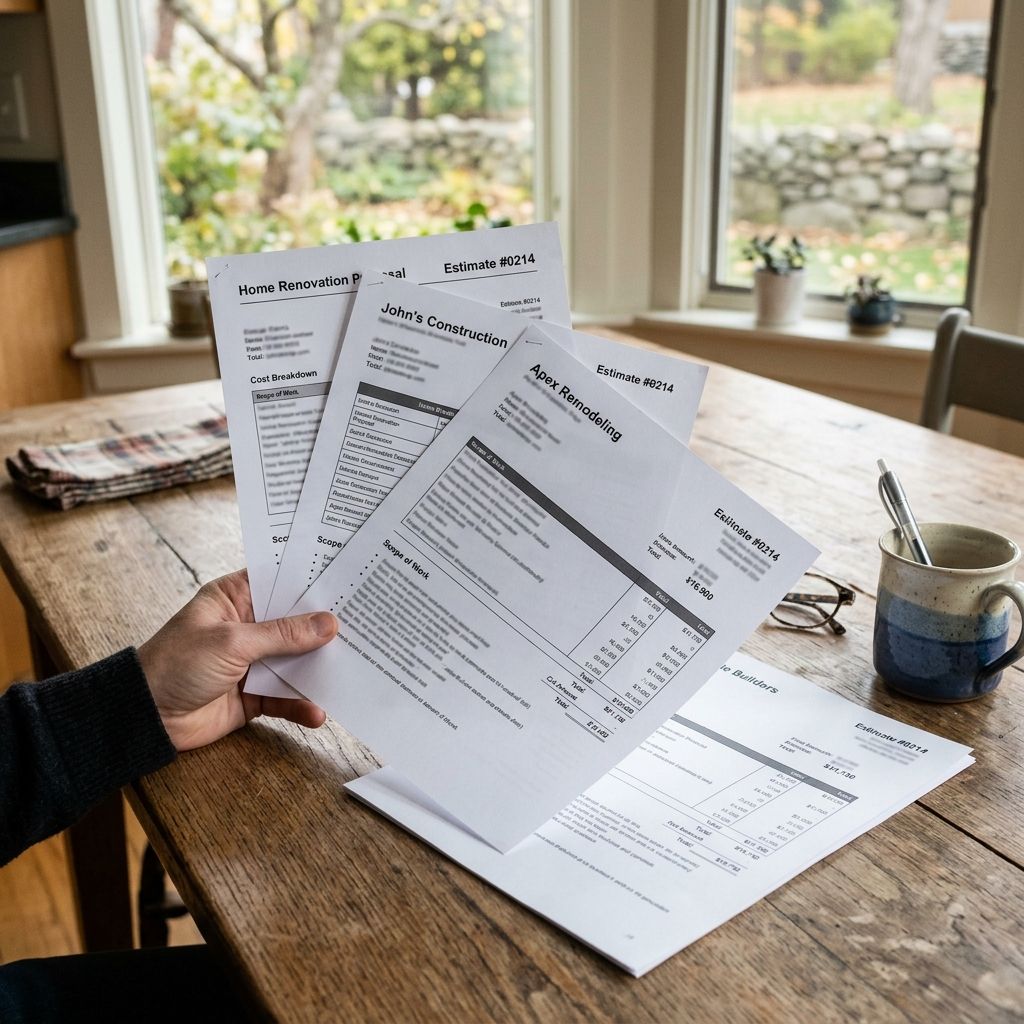
Last spring, a Salem homeowner showed me four estimates for the same roof. The numbers ran from $19,400 to $33,800. She assumed someone was cheating her. Nobody was — three of the four were honest documents. They just weren’t describing the same roof.
Why quotes for one roof differ by $14,000
A roofing estimate is a stack of decisions wearing a single number. Tear-off or overlay. Six feet of ice barrier or the code-minimum three. New flashing or “reuse existing.” Each decision moves the price quietly — and the cheapest quote is usually the one that made all those decisions in its own favor without telling you.
The fix isn’t finding the “real” price. It’s making every bid answer the same questions, in writing.
The line items that must be there
- Tear-off, named and priced. If the word “overlay” appears — or worse, nothing appears — ask. An overlay hides the deck, the one thing your new roof stands on.
- Deck repair terms. Nobody can see your sheathing through old shingles. What’s the per-plank price after the surprise? It should be on the page now, not negotiated at 2pm on demo day.
- Ice & water barrier, with footage. “Per code” means three feet. New England roofs want six at the eaves plus every valley. Footage is the tell.
- Flashing: new or reused. Reused flashing is the most common source of leaks on brand-new roofs. The estimate should say new, and say where.
- Ventilation math. Ridge vent without matching soffit intake is a decoration. Look for intake and exhaust both.
- Disposal, permits, and protection. Dumpster, town permit, tarps over the gardens — small lines, but their absence becomes your problem in week two.
Four questions that surface everything
Ask these of every bidder, and ask for the answers in writing. Honest outfits will enjoy answering; the others will get vague — equally useful information.
- “What happens if you find rotten decking?” You want a unit price and photos before replacement, not a change-order ambush.
- “Who exactly is on my roof — employees or subs?” Neither answer is evil, but it changes whose insurance and whose standards apply.
- “What does the workmanship warranty cover, and for how long?” Material warranties come from the factory; workmanship warranties tell you what the installer thinks of his own crew.
- “Can I see the certificate of insurance — today?” Liability and workers’ comp, current, with your address listed. A pro has this PDF ready before you finish the sentence.
Reading the silences
The most expensive words in a roofing estimate are the ones that aren’t there. “Allowance” means the number will move. “TBD” means it already has. And a price that’s 30% under everyone else isn’t a bargain — it’s a list of things you haven’t been told yet, scheduled to introduce themselves in July.
Take the week to compare properly. A good roof is a thirty-year decision; no honest contractor will pressure you into making it before dinner.